


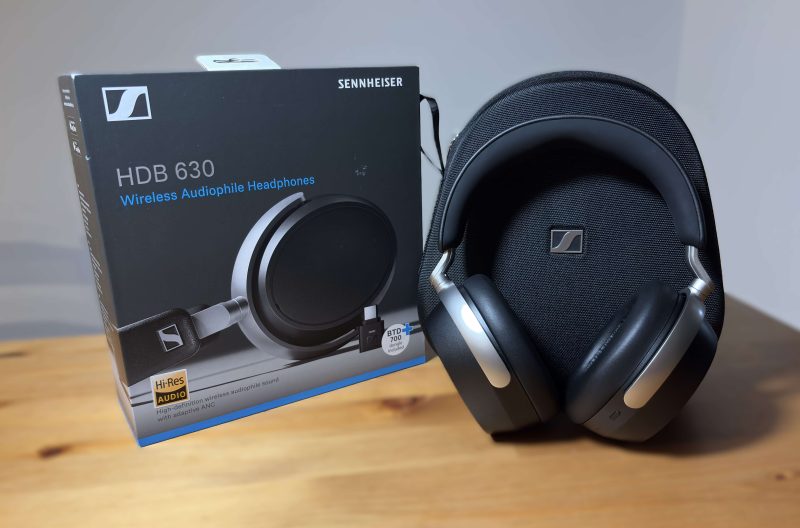
Disclosure: I’d like to thank Sennheiser for loaning me the HDB 630 for this review. All thoughts and opinions are my own, and Sennheiser had no say or input on the contents of this review.
The HDB 630 is the newest Bluetooth ANC headphone from Sennheiser, and what is different about the HDB 630 compared to their own Momentum 4, or even any other Bluetooth ANC headphone from Sony, Apple, Bose, etc., is that the HDB 630 is geared towards audiophiles. This is unique as no other major headphone brand has marketed, let alone designed, a Bluetooth ANC headphone specifically for audiophiles. Sennheiser says they have done this in two ways. First, the sound profile is said to be neutral yet detailed and rich. Second, the Smart Control Plus app provides a 5-band PEQ with various other ease-of-use features. This does sound intriguing indeed. HDB stands for “Headphone Dynamic Bluetooth” due to the number of codecs it supports, and the “6” in 630 signifies that this belongs to Sennheiser’s 6xx lineup of audiophile headphones, making this even more intriguing.
The audiophile community is hyped about this headphone, and there will undoubtedly be many reviews from respected audiophile reviewers, so I’ve decided to try to approach this review a little differently. There are many people who are what I call “casual audiophiles”, meaning they like the idea of a great audio experience, but do not have the time or energy to devote to learning every aspect of this hobby. This review is for you, casual audiophile person. I’ll mostly be focusing on the actual experience of using the Sennheiser HDB 630 in everyday life, as well as how it sounds and performs in different scenarios, while still keeping in mind the things that audiophiles want in their listening experience.
At $499 USD, the HDB 630 has a lot to prove, especially for a Bluetooth ANC headphone. Could this be a gateway headphone for the casual audiophile, or even the curious music listener, to enter the audiophile world? Let’s get into it and find out.
Key Specifications
- Product Page: https://www.sennheiser-hearing.com/en-US/p/hdb-630/
- MSRP: $ 499.95 USD
- Battery Life: Up to 60 hours per charge with ANC On
- Battery Capacity: 700 mAh
- Type: Closed-back over-ear
- Driver Type: 42mm Dynamic Driver
- Weight: 311g
- Connections: Bluetooth 5.2
- Codec support: SBC, AAC, aptX, aptX HD, aptX Adaptive
- Microphone: Yes, 4 microphones (2 per earcup)
- Active Noise Cancellation (ANC): Yes
- Charging Method: USB-C
- Weather/Dust Resistance: None
In the Box

- HDB 630
- BTD 700 Bluetooth dongle
- Hard zipper travel case
- 1.2 meter USB-C to USB-C cable
- 1.2 meter 2.5mm to 3.5mm cable
- Airplane adapter
- Manual
The travel case is very well made and quite sturdy, meaning it will survive being crushed in luggage or a backpack and provide more than adequate protection to the headphones. It is on the bulky side, but I honestly don’t mind, considering it can hold literally everything you need for the HDB 630.
Sennheiser has also opted to include the BTD 700 Bluetooth dongle to provide a consistent experience for everyone. Very thoughtful!


Design & Comfort

The Sennheiser HDB 630 closely resembles Sennheiser’s other Bluetooth ANC headphone, the Momentum 4. This is because it is mostly the same chassis with some subtle upgrades and changes. The earcups are slightly deeper, and the headband material is a bit nicer, with a soft black leatherette material.

For those who haven’t seen or used the Momentum 4, what I can say is that these will be one of the most comfortable Bluetooth ANC headphones you’ve ever worn. The earcups are spacious so that your ear does not touch any part of the inside of the cup (at least for me). The headband also has a decent amount of foam to cushion the top of your head and distribute the weight very evenly. The earcups also have an excellent swivel range to adjust to any head type. I always recommend trying headphones first, if possible, before buying to ensure they are comfortable for you, but for me, the HDB 630 fits better than anything from Sony or Bose. Only the AirPods Max is comparable in comfort for me.

As a glasses wearer, I am always concerned about comfort and cushions, and the HDB 630 does a marvelous job with its soft padded cushions to not only provide an excellent amount of passive noise isolation, but also presses just enough against the arms of my glasses without pressing them into my head. There is some heat buildup over time, which is natural for closed-back headphones, but it still feels nicely vented and never gets my ears hot or sweaty like the Sony WH-1000XM5 and XM6 do.


The actual look and color tone of the HDB 630 is very classy yet professional, in my opinion. The matte black chassis with silver accents on the earcup yokes and sliding mechanism make this headphone stand out, not in a flashy in your face kind of way, but in an understated elegance kind of way.

The actual build quality is excellent, with the headphones themselves feeling very solid. I didn’t hear any plastic creaking or squeaking, and to my pleasant surprise, the black materials don’t even pick up fingerprints very easily.

The controls are all located on the right earcup. Along the edge, there is the Multi-function button that controls power, Bluetooth pairing, and activating your voice assistant. Below that is the LED display for battery level, power status, and pairing status. Next is the USB-C connector, 2.5mm analog connection, and built-in microphone.
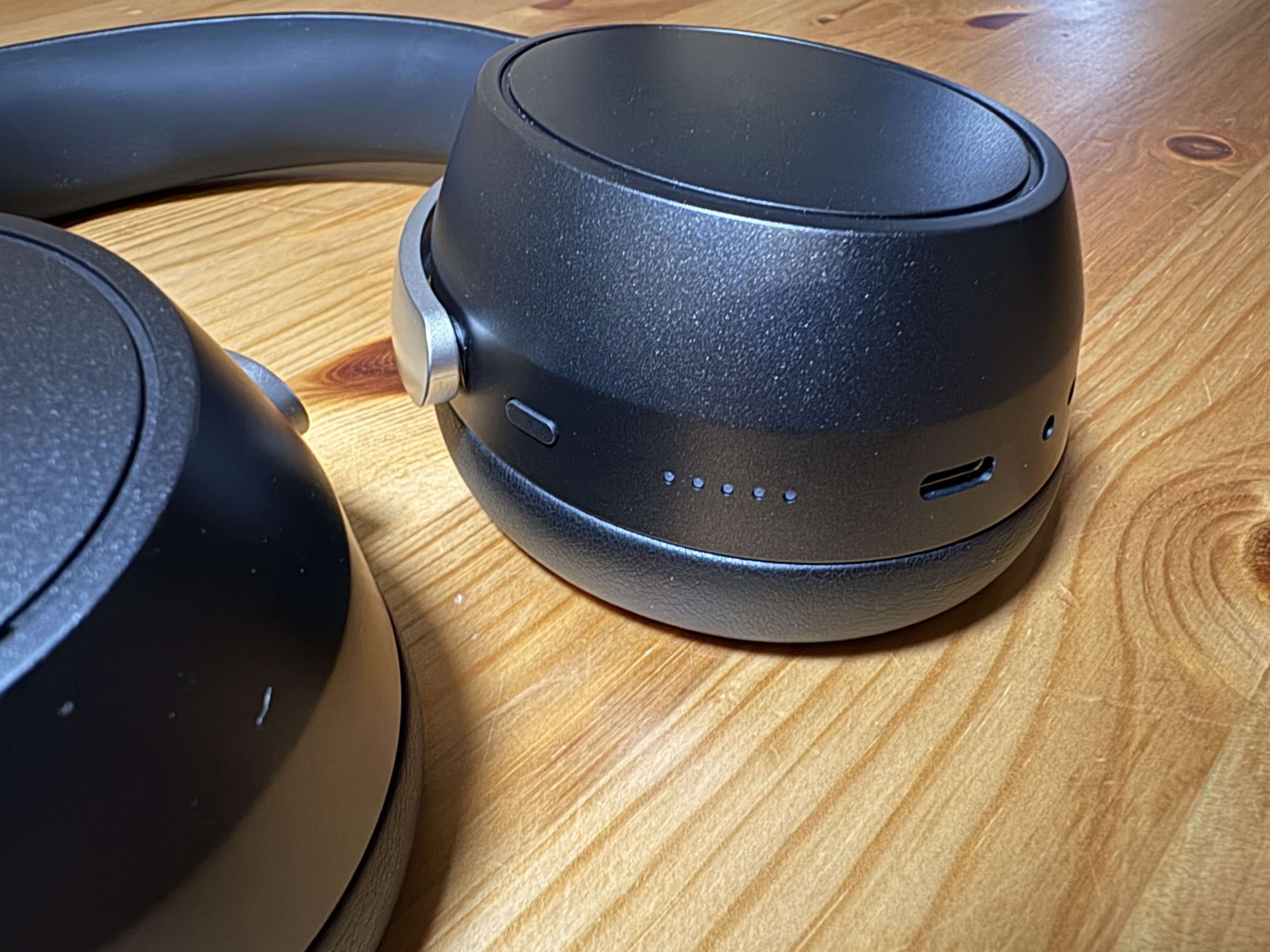

The faceplate of the right earcup contains the touch controls (more on those in the next section), and finally, the left earcup has a built-in microphone.
Usability

Using the Sennheiser HDB 630 is incredibly simple and intuitive, just as it should be. It has an automatic power-on feature that turns the headphones on as soon as you pick them up, which I thought I would hate but actually came to quite like, and rely on as well. You can also manually power on or power off the headphones by holding the multi-function button for 3 seconds, which will flash 1 LED light to indicate the state (white flashes 3 times is power on, red flashes 3 times is power off). The headphones make an audible chime when powered on or off.
If you need to pair the HDB 630, you simply hold the multi-function button for 5 seconds until you hear “Pairing”, or see the white LED lights flashing in sequence. Once connected, you will hear “connected” or “Pairing successful”. The audible tones and voices are very well done and never get in the way.
Now onto the touch controls. I am not a fan of touch controls, as I always tend to accidentally activate them at the worst times. I much prefer physical, tactile buttons. That being said, the controls here are really not that bad, nor too complicated:
- One tap is Play/Pause
- Two taps switch between ANC and Transparency modes
- Horizontal swipe forward and back is next and previous track
- Vertical swipe up and down is volume up and volume down
- Stretch and pinch increase and decrease transparency
They are also very responsive (on the Momentum 4, they seemed somewhat laggy or had a delay), so it’s great to see Sennheiser opted to improve the experience here.
The HDB 630 comes with the BTD 700 Bluetooth dongle, which is an effort by Sennheiser to ensure you are getting the best audio experience possible with these headphones. I recently reviewed the BTD 700, and by itself is a fantastic product, so it’s great to see that Sennheiser was thoughtful enough to include it here. The dongle uses USB-C, so it is able to connect to most modern devices, whether that be a smartphone, laptop, desktop PC, MacBook, iPad, Nintendo Switch, etc. The advantage here with the dongle is that you are not limited by what your source device supports in terms of Bluetooth codecs, or even if it has Bluetooth at all.
I mostly tested the BTD 700 and HDB 630 together with my Windows 11 desktop PC, Surface Laptop 7, Nintendo Switch 2, iPhone 16, and FiiO M21 digital audio player (DAP). They worked and performed flawlessly, and I was even able to walk about 15 meters away (50 feet) from the dongle while wearing the headphones, and the connection remained stable with no noticeable drop in audio quality. The biggest advantage of the BTD 700, in my opinion, is that it has a built-in Gaming Mode. This reduces the latency to around 30ms, which allows you to watch videos and have no noticeable sync issues between audio and video. It also allows you to play games, which I did do.

The best example of this is with my Nintendo Switch 2. Now, one thing you do have to do in order to retain the aptX Adaptive codec experience is, once you plug the BTD 700 into the Switch 2 (this also applies to the original Switch, as well as the PS5) is set the microphone input to the System microphone and not the BTD 700. This will make sure you are not using the hands-free Bluetooth profile, which has terrible audio, and instead will activate aptX Adaptive. Then, press the dongle’s button three times until it turns green to activate Gaming Mode, and now you have aptX Adaptive sound with almost no latency. Pure gaming bliss.
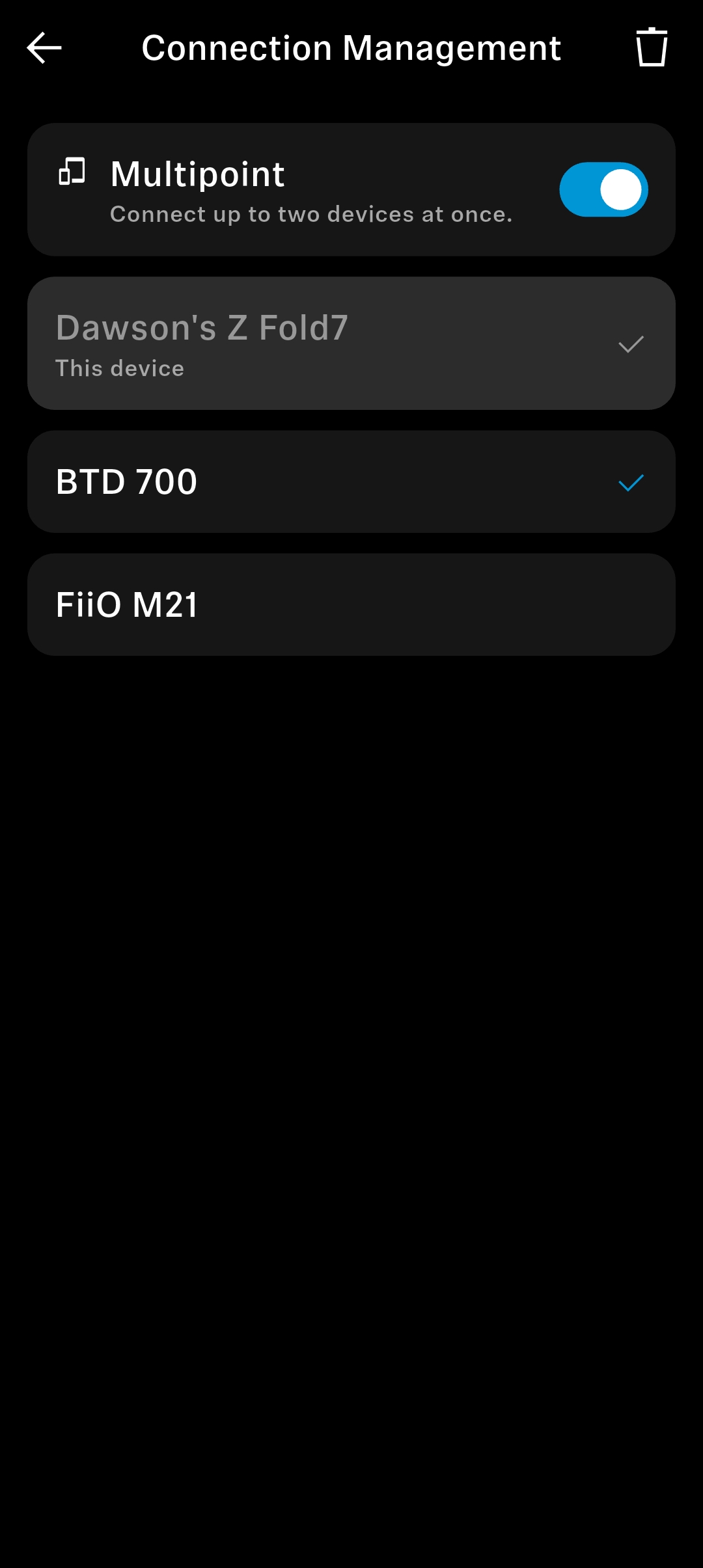
The HDB 630 supports multipoint Bluetooth connections, which makes it incredibly convenient to have it connected to the BTD 700 or a computer, and still be able to use the app on your smartphone to change settings and even verify the codec used. Sennheiser really thought of everything here.

The last thing I will touch on is the various connection methods. Aside from Bluetooth, you have the ability to connect to a 3.5mm connection using the provided 2.5mm to 3.5mm cable, as well as use USB-C as an audio connection. I did not find a sound quality difference between any of these connections, and they all worked exactly as they should. The HDB 630 shows up as a 24-bit/96KHz device in Windows when connected with USB-C. One thing to note is that you cannot use the built-in microphone with the 2.5mm to 3.5mm connection; it only works via Bluetooth or USB-C connection. And the very last thing to note, the headphones cannot be used passively; they need to be powered on in order to hear any audio.
ANC and Transparency
The HDB 630’s ANC performance is very good. Paired with its great passive noise isolation, the ANC does a great job of filtering out most sounds, as well as compensating for the slight earcup seal break for those of us who wear glasses. ANC headphones like the AirPods Max and Sonos Ace perform slightly better to my ears, but the HDB 630 is definitely near the top now among other leading brands, whereas the Momentum 4’s ANC performance was “good enough”. There’s an anti-wind feature that I found worked very well when walking outside, helping to cut down on the noise created by wind.
One thing I did notice is that there is almost no white noise when ANC is maxed out. With many ANC headphones, there is a perceptible “hissing” sound that can be heard when no audio is playing. I didn’t really hear anything with the HDB 630, which is great, as white noise does irritate me.
The transparency mode is decent. It’s not as good as anything from Apple, and performs slightly better than Sony’s models. I also found that setting Transparency above 60% tends to overly exaggerate sounds to the point where it sounds overwhelming. Around 40% was the sweet spot for me. It does a good job overall, though.
Companion App
The Sennheiser Smart Control Plus app on iOS and Android (not to be confused with the Sennheiser Smart Control app) is used to control, manage, and view settings and update firmware for the HDB 630. Once you pair the HDB 630 to your phone and open the app, you are presented with a fairly clean and logically laid out main page. So let’s go over the relevant sections.
My sound is where you are able to change settings that will affect the sound profile of the headphone. Here you have several options: Parametric EQ, Graphic EQ, a Bass Boost toggle, and Podcast mode.


Parametric EQ is interesting, as this is not something that has ever been offered for a Bluetooth ANC headphone before. It offers much more granular control compared to the traditional Graphic EQ. Selecting either EQ option will show the available preset EQ profiles, which I found to work generally very well, depending on the type of sound you want. The default is “Neutral”. The Podcast EQ, for example, is great for spoken word content and eases some long-term listening fatigue while enhancing vocal clarity.
If you select “Create New,” it gives you three options: a guided EQ with Sennheiser’s Sound Check (it actually does a good job in my experience), and the options to create a new EQ using either GEQ or PEQ. When using Parametric EQ, you have up to 5 bands to work with, with options to A/B test between different EQ options, as well as a bypass to hear your EQ compared to the Neutral default profile. This is very powerful stuff, and it really gives you a lot of flexibility to tune the sound to exactly how you want it.


Going back to the main screen, we have a new Crossfeed section. What this does is blend some of the bass response so that it is sent to both of your ears at the same time, making it feel as if the music is surrounding you as opposed to having distinct left and right sounds. It’s a really neat effect that does sound great on a per-track basis, in my experience. I think Low is a good option to leave it on for the most part, but it’s something you should play with to hear how it sounds to you.
Next is the connection management section, which allows you to select which devices you want the headphones to be connected to.
Noise control allows you to select the intensity of the ANC and Transparency modes, toggle the Anti-wind feature, or enable Adaptive mode.


Controls allow you to see the controls or disable the touch controls completely.
Going to the Settings page, this is the most interesting in my opinion. Here, you are able to select the audio priority, which allows you to enable or disable 24-bit/96KHz support. The codec section displays the available codecs and which one is currently in use for the currently playing audio. This is such a great feature, and gives you peace of mind as to what codec you are using.
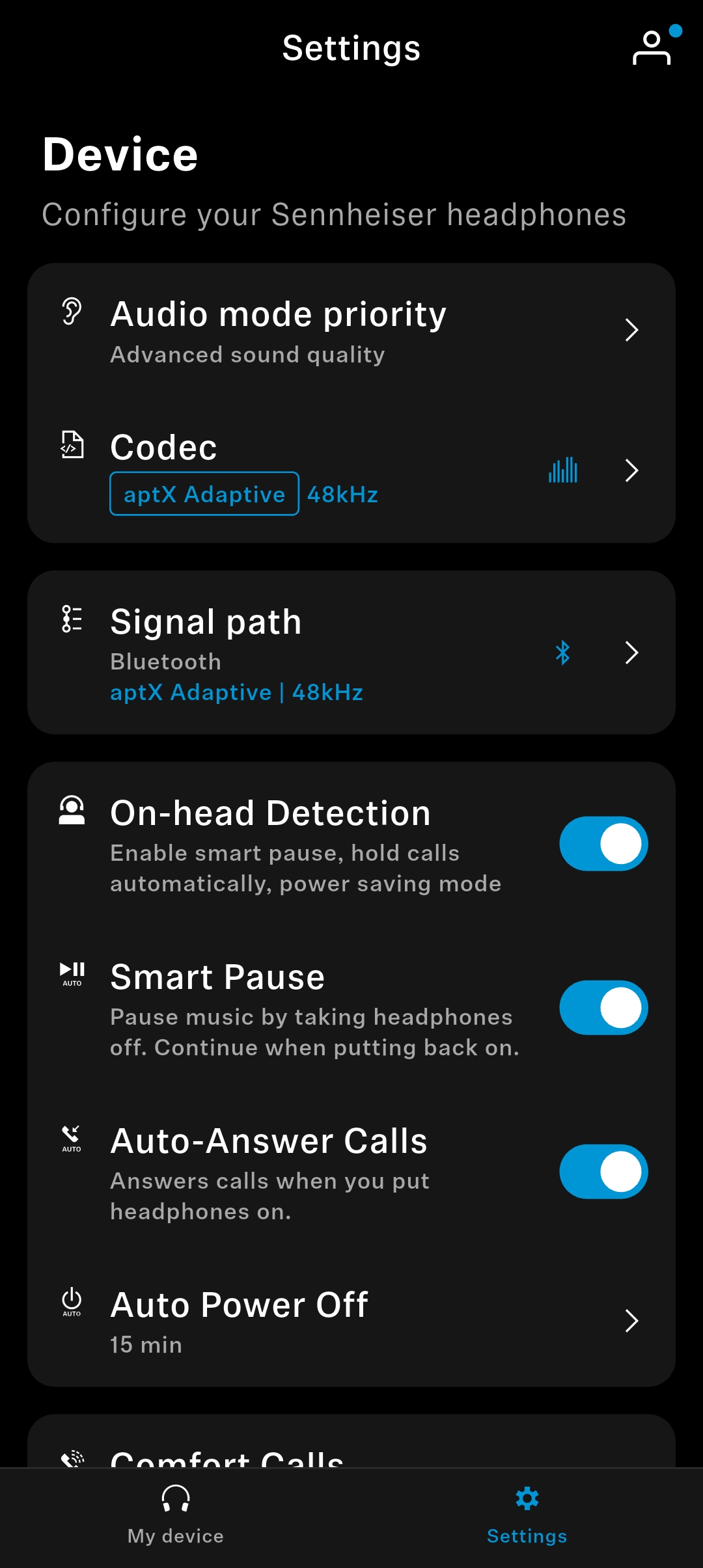


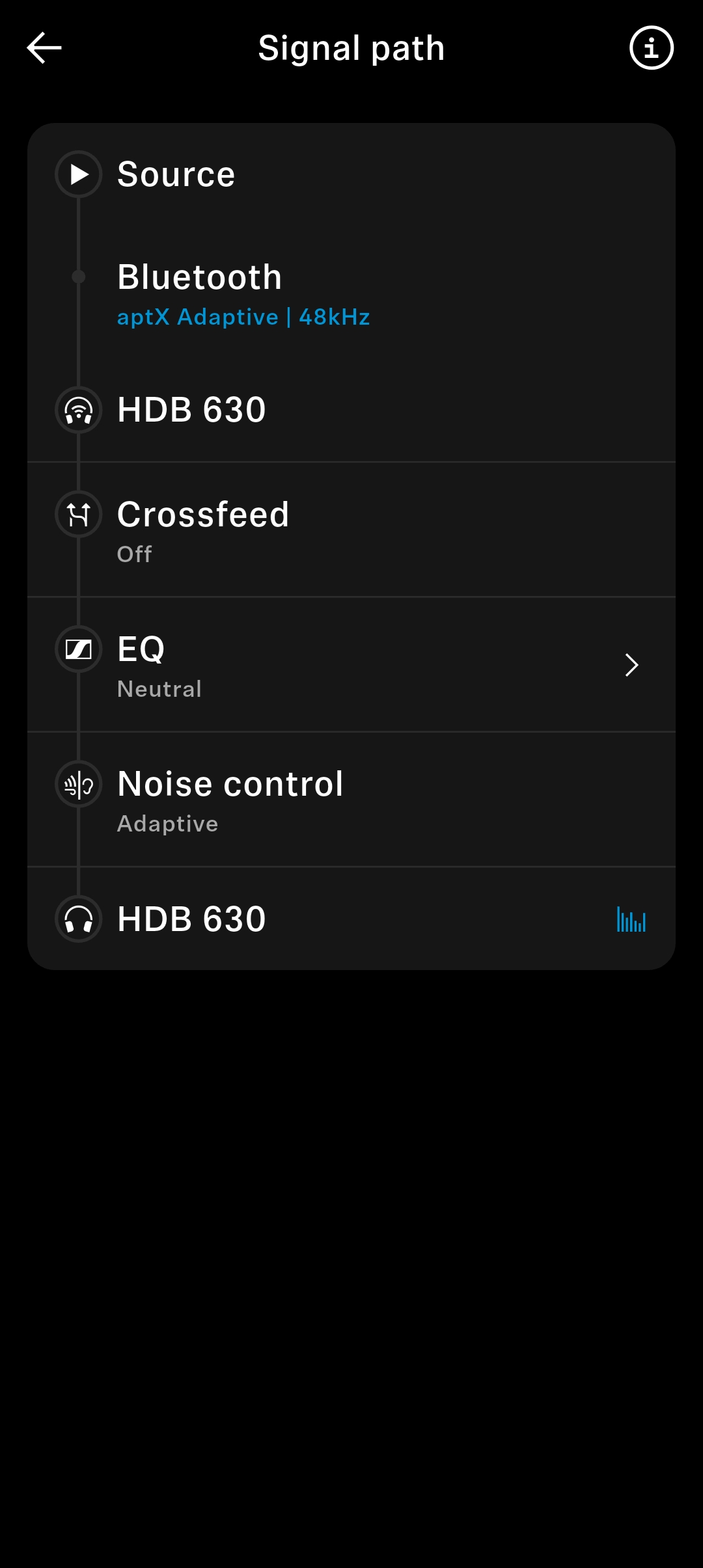
My favorite thing, though, is the Signal path section, which shows the audio signal chain from the source device to the headphones. This is useful not only to see all of the aspects affecting the sound quality, but also to troubleshoot if you are encountering issues.
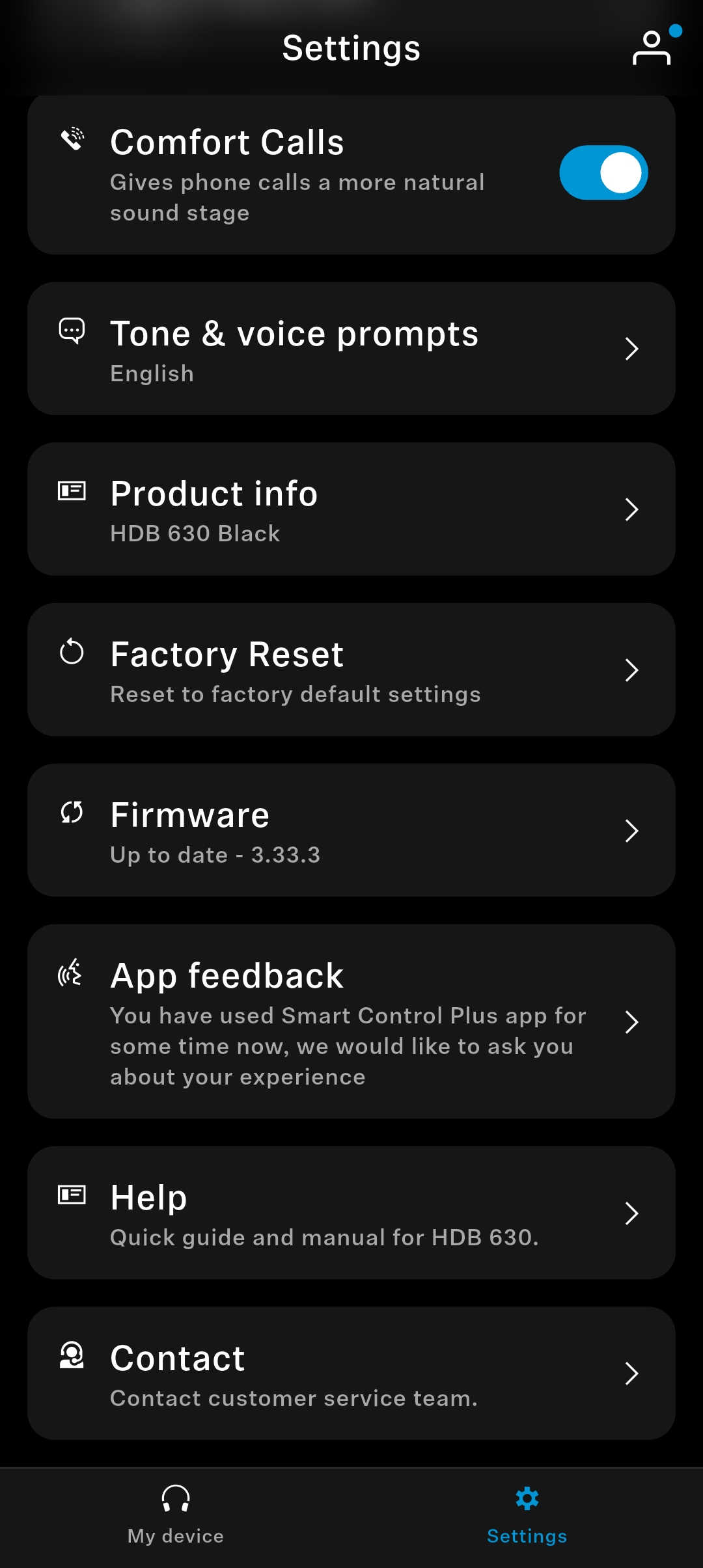
Finally, you have all the other various settings, such as Tone prompts, reset options, and the firmware update check. The app is actually really good, fluid, and quick to use and connect to the headphones. Sennheiser did a fantastic job here.
Battery
Sennheiser usually does a good job with battery life with their Bluetooth headphones and TWS earbuds, and the HDB 630 is no exception. The stated battery life is 60 hours of audio playback with ANC enabled. In my testing, it comes very close to this, regardless of what Bluetooth codec I am using. For the most part, I was getting between 55 hours and 59 hours of playback time, which really is phenomenal.
Charging time is also excellent, with 2 hours required to get to a full charge from empty, and a 10-minute charge offering about 7 hours of playback time. This helps make the HDB 630 great commuter and travel headphones, whether you’re an audiophile or not.
Sound Quality
Sources used for this review:
- Windows 11 desktop PC (BTD 700)
- Surface Laptop 7 (BTD 700)
- Samsung Galaxy Fold 7 (aptX, BTD 700)
- Apple iPhone 16 (BTD 700)
- FiiO M21 (aptX HD, BTD 700)
- Nintendo Switch 2 (BTD 700)
Links to my music playlist used for the majority of testing:
Spotify: https://open.spotify.com/playlist/6QSIhuCBDAUyoWGcyxPeN8?si=c0a4eb6bd3e3421e
Apple Music: https://music.apple.com/ca/playlist/hifi-oasis-audio-testing/pl.u-lKWlcjy04xp
Tidal: https://tidal.com/playlist/503485c7-7f3d-43f0-b904-4b9a89c33875

Finally, we are here to talk about the sound of the Sennheiser HDB 630, and to be honest, this is not what I was expecting. I really just expected a refinement of the Momentum 4 headphones, with most of the focus being on the ability to use the Parametric EQ in the app to tune the sound. I was dead wrong in my expectation.
Sennheiser states in their press material that they aimed for a neutral yet natural sound profile that retains detail. I can confirm that is exactly what it sounds like. To the casual audiophile, you may notice the HDB 630 to have a less lively or musical sound to it than that of Sony or Bose. This will be due to less emphasis on the bass region, as well as the upper treble. To some people, the heavy emphasis on bass performance that you get with most consumer ANC headphones makes them sound “better”, more musical, and have more energy. In reality, it may sound like it, but you lose so much detail and subtlety with this type of tuning. So let’s look at the bass, midrange, and treble from this perspective.
Bass
The bass sounds much more like how an audiophile would expect it to be. It’s fairly lean compared to most ANC headphones, but it retains a good amount of punch and definition. It is not in your face, but if you listen to tracks like Angel by Massive Attack, or Avaritia by deadmau5, the sub-bass and mid-bass are going to be noticeable and hit you when needed. You can actually hear the distinctness between instruments and notes, whereas on something like my Sony WH-1000XM5, they get drowned out and sound claustrophobic.
There is definitely a bass presence here, but if you are not prepared, you may feel it is too lean, whereas it offers just the right amount of punch and texture to my ears.
Midrange
The midrange is my favorite area of the HDB 630. It sounds smooth, with male and female vocals both coming across naturally. Male vocals retain their thickness and body, especially for singers in the grungy music I typically listen to. The not overly done bass helps with this, and also helps keep them clearly defined. Female vocals have great texture and sound just phenomenal in my opinion, retaining great clarity without any hint of sibilance. A couple of highlights for me are anything by Dire Straits or Kate Bush. Mark Knopfler’s vocals are very clear but retain the thickness and body when he exhibits a deeper voice. Kate Bush sounds breathy, and her range is wonderfully captured, especially on a track like Running Up That Hill.
The midrange definitely has that smooth and warm characteristic of Sennheiser’s audiophile headphones, which, for a closed-back, is really surprising to me. Everything here sounds balanced and clear while not sacrificing richness.
Treble
The treble sounds very pleasant to my ears. It isn’t sibilant or harsh, or even sharp, yet has a distinct airy quality and retains a lot of detail. This helps make HDB 630 sound more spacious than it is, despite being a closed-back headphone. Cymbals are very clear and sound brassy, yet don’t hurt your ears when there’s a clash. One test I like to do is listen to Reckoner by Radiohead to see how long it takes for the cymbals to fatigue my ears. Nothing like that here, but their sound is natural and distinct.
Soundstage and Imaging
For a closed-back headphone, the HDB 630 presents a fairly natural and spacious soundstage. It doesn’t make music sound too intimate, but if a song calls for it you can definitely still get that feeling. Imaging is excellent, and you can distinctly hear sounds coming from the left and right sides.
Final Thoughts

Sennheiser clearly put a lot of intention into the sound tuning of the HDB 630. They could have just put out a “Momentum 5” (maybe they will?) with some iterative upgrades and called it a day, but they chose to enter a new category. I think the HDB 630 sounds fantastic, and it does allow for both enjoyable, relaxing, casual music listening, as well as critical listening, which audiophiles tend to like to do. It’s very hard to cater to both groups, but I think Sennheiser has successfully done just that.
The casual audiophile will surely find the HDB 630 an excellent gateway headphone into the audiophile hobby, one that still has practical uses as an excellent commuter and travel headphone. Those uses alone may help to justify the $499 USD price, but only you can be the judge of that.
I do find it funny that, while Sennheiser finally gave us a parametric EQ to use, I never felt the need to use it. I do appreciate it being there, though.
The only fault I can find with the HDB 630 is the touch controls, which I still do not like, and as I previously said, I would very much prefer physical controls that give tactile feedback when pressed. I guess I could also nitpick and say that I wish the HDB 630 supported the aptX Lossless codec, to truly give it the audiophile badge.
Aside from those two issues, the Sennheiser HDB 630 is the perfect Bluetooth ANC headphone for both audiophiles and casual audiophiles. It’s still very practical, looks great, is built well, and most importantly, sounds fantastic.

Buy from Amazon: https://amzn.to/3MVTV8M
Check Price Online: https://geni.us/44zSt
I’m not always able to cover all the details of a product, both hardware and software, in our reviews. If you have any specific questions about this product, please feel free to leave a comment or contact me directly.
Be sure to check out our excellent Buyer’s Guides, as well as our other Reviews.
HiFi Oasis Verdict
HiFi Oasis Verdict-
Design & Comfort9/10 Amazing
-
Sound9/10 Amazing
-
Features/Accessories9/10 Amazing
-
Value8/10 Very good
Pros
- Sound profile that is neutral yet detailed and natural sounding
- Supports most major Bluetooth codecs
- Crossfeed feature is very useful and sounds great
- Long battery life
- Very comfortable to wear, even for people with glasses
- Excellent build quality and attractive design
- Multiple connection methods - Bluetooth, USB-C, 3.5mm
- Included travel case is very well made and offers solid protection
- Includes the BTD 700 dongle
- ANC performance competes with other major flagship ANC headphones
Cons
- Touch controls can be accidentally activated
- Transparency mode is just OK
- No aptX Lossless support
- Travel case may be too bulky for some


Excellent review Dawson!
Thank you!
Interesting review. Sennheiser‘s decision to include the aptx lossless dongle, but to not equip the headphones with aptx lossless capabilities makes no sense whatsoever. Even the momentum 4 supports lossless! Why not this more expensive sibling?
I think the decision not to include aptX Lossless is mostly due to the fact that Bluetooth ANC headphones are typically used in interference-heavy environments, and aptX Lossless is very susceptible to interference. I do agree, though, that it really should have been included in a headphone market for audiophiles.
Also, the Momentum 4 doesn’t support aptX Lossless, but the Momentum True Wireless 4 earbuds do.